The York County Astronomical Society,* celebrating 14 years offering planetarium programs to the public, is now offering Saturday afternoon programs for young children and families and Saturday evening for older family members at the York Learning Center Planetarium. This month we are featuring a children’s program, One World, One Sky: Big Bird’s Adventure, and Max Goes to the Moon. For older family members, there is Hot & Energetic Universe at the planetarium, and The Sun: Our Living Star.
Show date is Saturday, February 22, 2020 at:
2:00pm One World, One Sky
2:40pm StarWatch
3:20pm Max Goes to the Moon
7:00pm Hot & Energetic Universe
7:40pm StarWatch
8:20pm The Sun: Our Living Star
The planetarium is located in the York Learning Center at 301 East 6th Avenue in York. Admission is $4.00 for adults, $3.00 for children and seniors. Admission to any second or third show is $1.00 each. Cash and most credit and debit cards are accepted. Private shows reservations are available. Our new website is AstroYork.com.
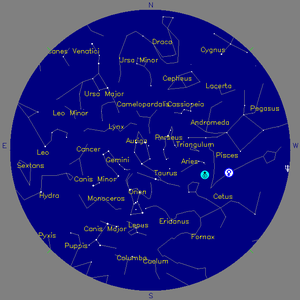
StarWatch Become a star watcher by exploring the current night sky, locate visible planets and constellations, and enjoy some sky lore. Receive a star map and get a tour of tonight’s sky.
In One World, One Sky: Big Bird’s Adventure! Elmo and Big Bird live in the United States and Hu Hu Zhu lives far away in China, but they discovered that they still see the same stars at night! The word for star in Chinese is “xing xing” (pronounced sing sing). How many “xing xing” do you see in this sky? When Elmo and Hu Hu Zhu "travel" to the moon, they discover some basic but surprising scientific facts. For example, they can't fly a kite there because there is no wind. The fuzzy friends then excitedly realize that children like to fly kites in both China and the United States!
In Max Goes to the Moon children’s planetarium program, Max (the dog) and a young girl named Tori take the first trip to the Moon since the Apollo era. Along the way, the story sets the stage for the topics including “Phases of the Moon,” “Wings in Space?”, and “Frisbees and Curve Balls on the Moon” - all thoughtfully explained so that grownups and children can learn together about science. Toward the end, Max and Tori’s trip proves so inspiring to people back on Earth that all the nations of the world come together to build a great Moon colony from which “the beautiful views of Earth from the Moon made everyone realize that we all share a small and precious planet.”
“The Hot and Energetic Universe” presents the fascinating world of high energy astrophysics. High energy astrophysics plays a key role in understanding the universe, as these radiations reveal the processes in the hot and violent universe. High energy astrophysics probes hot gas in clusters of galaxies, which are the most massive objects in the universe. It also probes hot gas accreting around supermassive black holes in the centers of galaxies. Finally, high energy radiation provides important information about our own galaxy, neutron stars, supernova remnants and stars like our Sun which emit copious amounts of high-energy radiation. Come and learn about your hot and energetic universe!
The Sun: Our Living Star - The Sun has shone on our world for four and a half billion years.
The light that warms our skin today has been felt by every person who has ever lived. It is our nearest star and our planet’s powerhouse, the source of the energy that drives our winds, our weather and all life. The passage of the Sun’s fiery disc across the sky - day by day, month by month - was the only way to keep track of time for countless past civilizations. Don’t be fooled by the terminology; although it is a typical dwarf star, the Sun consumes 600 million tons of hydrogen each second and is 500 times as massive as all the planets combined.
Show date is Saturday, February 22, 2020 at:
2:00pm One World, One Sky
2:40pm StarWatch
3:20pm Max Goes to the Moon
7:00pm Hot & Energetic Universe
7:40pm StarWatch
8:20pm The Sun: Our Living Star
The planetarium is located in the York Learning Center at 301 East 6th Avenue in York. Admission is $4.00 for adults, $3.00 for children and seniors. Admission to any second or third show is $1.00 each. Cash and most credit and debit cards are accepted. Private shows reservations are available. Our new website is AstroYork.com.
StarWatch Become a star watcher by exploring the current night sky, locate visible planets and constellations, and enjoy some sky lore. Receive a star map and get a tour of tonight’s sky.
In One World, One Sky: Big Bird’s Adventure! Elmo and Big Bird live in the United States and Hu Hu Zhu lives far away in China, but they discovered that they still see the same stars at night! The word for star in Chinese is “xing xing” (pronounced sing sing). How many “xing xing” do you see in this sky? When Elmo and Hu Hu Zhu "travel" to the moon, they discover some basic but surprising scientific facts. For example, they can't fly a kite there because there is no wind. The fuzzy friends then excitedly realize that children like to fly kites in both China and the United States!
In Max Goes to the Moon children’s planetarium program, Max (the dog) and a young girl named Tori take the first trip to the Moon since the Apollo era. Along the way, the story sets the stage for the topics including “Phases of the Moon,” “Wings in Space?”, and “Frisbees and Curve Balls on the Moon” - all thoughtfully explained so that grownups and children can learn together about science. Toward the end, Max and Tori’s trip proves so inspiring to people back on Earth that all the nations of the world come together to build a great Moon colony from which “the beautiful views of Earth from the Moon made everyone realize that we all share a small and precious planet.”
“The Hot and Energetic Universe” presents the fascinating world of high energy astrophysics. High energy astrophysics plays a key role in understanding the universe, as these radiations reveal the processes in the hot and violent universe. High energy astrophysics probes hot gas in clusters of galaxies, which are the most massive objects in the universe. It also probes hot gas accreting around supermassive black holes in the centers of galaxies. Finally, high energy radiation provides important information about our own galaxy, neutron stars, supernova remnants and stars like our Sun which emit copious amounts of high-energy radiation. Come and learn about your hot and energetic universe!
The Sun: Our Living Star - The Sun has shone on our world for four and a half billion years.
The light that warms our skin today has been felt by every person who has ever lived. It is our nearest star and our planet’s powerhouse, the source of the energy that drives our winds, our weather and all life. The passage of the Sun’s fiery disc across the sky - day by day, month by month - was the only way to keep track of time for countless past civilizations. Don’t be fooled by the terminology; although it is a typical dwarf star, the Sun consumes 600 million tons of hydrogen each second and is 500 times as massive as all the planets combined.
Date: Saturday, February 22, 2020
Time: 2 p.m. - 9 p.m. Eastern
Location:
The York Learning Center Planetarium
E 6th Ave
Elk St
North York, PA 17404