2026 Astronomy presentations & night sky observing are on the 2nd Saturday of each month (April - November). The only Arizona State Park with a permanent observatory.
Winslow Homolovi Observatory
HOMOLOVI STATE PARK – WINSLOW, ARIZONA
NIGHT SKY HIGHLIGHT: August 2026
Warmer weather brings great opportunities to explore the night sky. August 2026 Highlights:
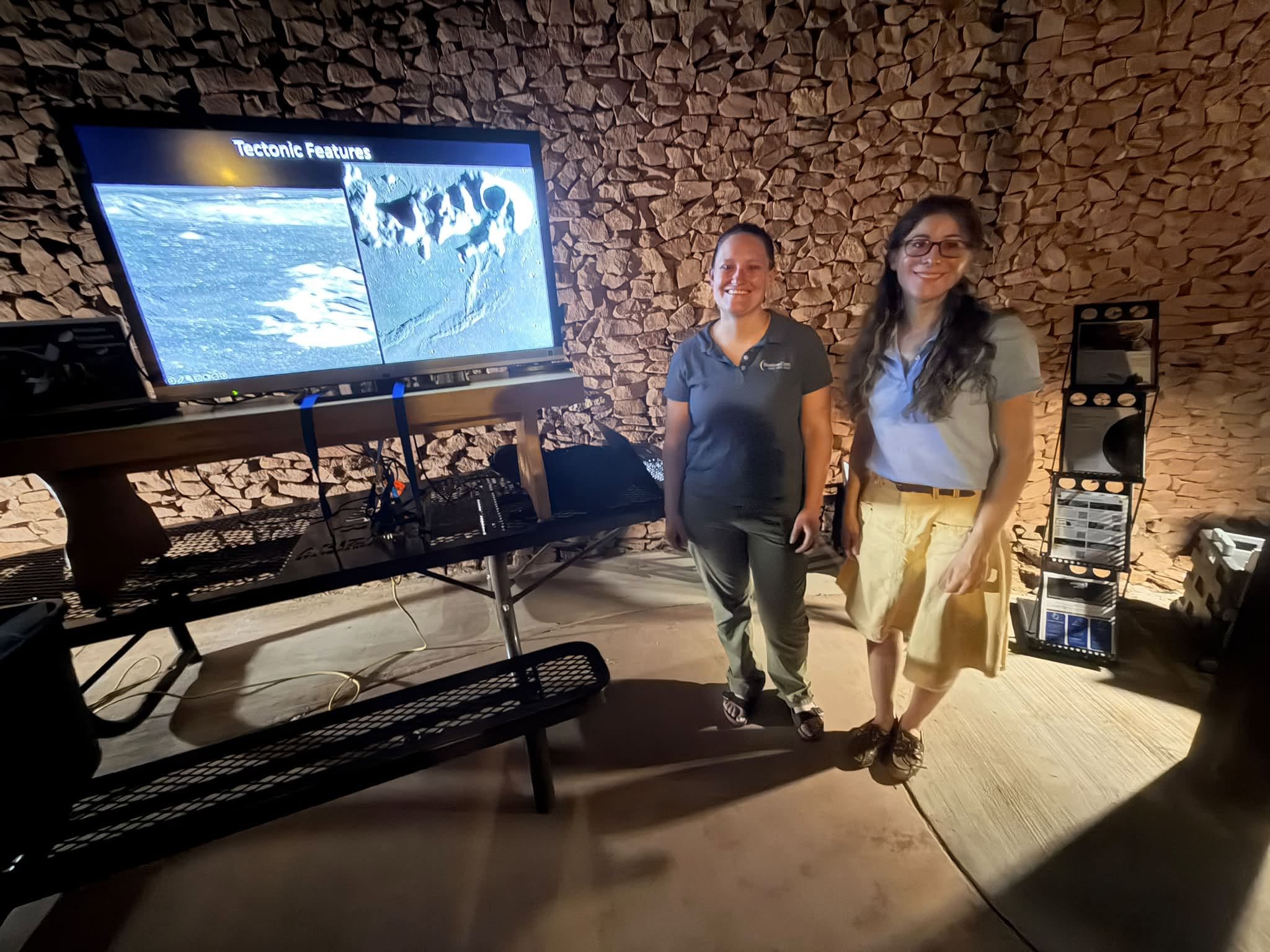
Winslow Homolovi Observatory Opens at 7:00 PM (AZ-MST). Our guest presenter is the LROC crew. The Lunar Reconnaissance Orbiter Camera (LROC) Science Operations Center (SOC) team has been acquiring and analyzing high-resolution images of the Moon for about 17 years as part of NASA’s Lunar Reconnaissance Orbiter (LRO) mission. The team is responsible for the full data lifecycle including capturing, calibrating, processing, archiving, and distributing observation data through NASA’s Planetary Data System (PDS), with new and updated data products released on a regular cadence. These datasets support a wide range of scientific investigations, from impact processes and surface evolution to illumination conditions and resource identification. LROC data plays a critical role in planning current and future exploration efforts like identifying and characterizing safe landing sites, assessing terrain hazards, and supporting mission operations for both robotic and human exploration. In addition, the team develops publicly accessible tools and outreach resources that enable scientists, mission planners, educators, and the broader public to explore and better understand the Moon.
The Lunar Reconnaissance Orbiter Camera, or LROC, is a system of three (3) cameras mounted on the Lunar Reconnaissance Orbiter (LRO) that capture high resolution black and white images and moderate resolution multi-spectral images of the lunar surface. LROC consists of two Narrow Angle Cameras (NACs) that are designed to provide 0.5 meter-scale panchromatic images over a 5 km swath, and a Wide-Angle Camera (WAC) that provides images at a scale of 100 meters/pixel in seven color bands over a 60 km swath. The Sequence and Compressor System (SCS) supports data acquisition for both cameras. LROC is a modified version of the Mars Reconnaissance Orbiter's ConTeXt Camera (CTX) and Mars Color Imager (MARCI). Teachers are encouraged to contact Homolovi State Park if they are going to attend to reserve their teacher packet. These tools can be used in their classrooms and are also available for download at https://lroc.im-ldi.com/educators/activities.
Evening observations through the Moore Telescope begin at 8:00 PM (AZ-MST). Homolovi State Park Star Parties are conducted on the second Saturday each month. Star parties for April - August begin at 7:00 PM with our guest speaker’s bureau. September through November begin at 6:00 PM. All times are Arizona Mountain Standard. Arizona doesn’t observe day-light savings time.
Our August 8, 2026 Winslow Homolovi Observatory Star Party Observation targets through the Moore 14" SCT telescope may include as night sky weather conditions permit:
- (M24) Messier 24 is not a specific object but a space between dark interstellar dust clouds, that block light and create gaps in the star-scape through which millions of stars are viewable. Charles Messier entered this into his catalog of night sky objects on June 29,1764, terming it “a large nebulosity in which there are many stars of different magnitudes.”
- (M57) The Ring Nebula: Located in the constellation Lyra, this is a beautiful planetary nebula that sits well overhead in the mid-to-late evening. M57 was the second planetary nebula to be discovered on January 31, 1779, 15 years after the first one (Messier 27) had also found and cataloged it. Some days later, in February 1779, Antoine Darquier de Pellepoix also observed this nebula. He described it as "a dull nebula, but perfectly outlined; as large as Jupiter and looks like a fading planet." Charles Messier mentions Antione Darquier's observation as a discovery, and thus gave rise to a long-standing erroneous assumption that Darquier might have been the discoverer; the error was found by Giovanni Maria ("Giangi") Caglieris in 2013 and published together with Donald Olson in 2017. Expanding and correcting a footnote in the history of astronomy.
- (M13) The Hercules Cluster: A spectacular, dense globular cluster of hundreds of thousands of stars, best viewed as it climbs high into the eastern sky. Astronomer Edmond Halley, of Halley's comet fame, discovered Messier 13 in 1714. Edmond Halley formally announced it in a 1715 publication, simply describing it as a "little patch."
- (M11) Wild Duck Cluster: This cluster's brightest stars form a rough V-shape that resembles a flock of migrating waterfowl, giving it the common name of Wild Duck Cluster. Discovered by German astronomer Gottfried Kirch in 1681 at the Berlin Observatory, Kirch described it as a "small, obscure spot with a star shining through" is located 6,200 light-years from Earth in the constellation Scutum.
Planets & Celestial Events
On August 8, 2026, the evening sky in Winslow, Arizona, will feature Saturn around 9:00 PM accompanied by a waning crescent moon and the peak run-up to the Perseid meteor shower. You can expect to see early meteors streaking across the sky, particularly after midnight when the radiant point climbs higher.
Ranger/Volunteer Lead opportunities for black-lighting scorpions and desert critters may be available. (TBD).
The premier celestial events in Arizona for August 2026 include:
- Perseid Meteor Shower (August 11–13): Widely considered the best meteor shower of the year, the Perseids are active from mid-July through late August. The peak occurs overnight, and because the moon will be nearly new, viewing conditions will be exceptionally dark. Expect to see 50 to 100 meteors per hour in dark-sky locations.
- Lunar Alignment with Mars & Saturn (Mid-August): The moon will pass through the night sky accompanied by a planetary parade featuring Mars and Saturn. Both planets will be visible to the naked eye alongside the waxing moon.
- Sturgeon Full Moon & Supermoon (August 28): The August full moon will be one of the closest and largest full moons of the year, shining brightly over the desert landscapes. Moonset will be at 6:18 am, Moonrise is 7:13 pm at 242,283 miles from Earth with 100% illumination. Best viewed with sunglasses to highlight the craters and valleys.
September 12, 2026 Guest Speaker: David Mayer. "How to Land a Rover on Mars" David Mayer is a Geographer at the USGS Astrogeology Science Center where he specializes in creating and analyzing topographic maps of planets and moons throughout our solar system. He also leads the planetary geodesy project team in Astrogeology and helps maintain the digital archive of images collected by NASA spacecraft from 1966 to the present. David earned a master's degree in Earth and planetary geology from Washington University in St. Louis in 2009 and a master's degree in geography from Clark University in 2013.
Save the Date: September 19, 2026 You're invited! Observe the Moon with NASA. Each year, observers around the world come together to celebrate Earth's Moon through direct observations, hands-on activities, lunar-themed music, artwork, readings, and more.
Join in from wherever you are: Attend or host a virtual or in-person event, or observe the Moon from home. Sign up here for this great annual event.
https://science.nasa.gov/moon/observe-the-moon-night/
Hours
- Summer hrs. 7 p.m. - 9:30 p.m. MST April, May, June, July August
- Winter hrs. 6 p.m. - 8:30 p.m. MST September, October, November
- The first hour is a presentation in the park visitor center
- The remaining 90 minutes will be observations through the Moore 14" SCT telescope
Date: Saturday, August 8, 2026
Time: 7 p.m. Mountain
Location:
Homolovi State Park Winslow Homolovi Observatory
Winslow, AZ 86047